Strategic Corridors for American High-Speed Rail
USJIA supports the advancement of high-speed rail across three U.S. corridor contexts where the case for proven Japanese technology is most compelling. These are not promotional project summaries — they are strategic assessments of where and why transformative rail investment is warranted.
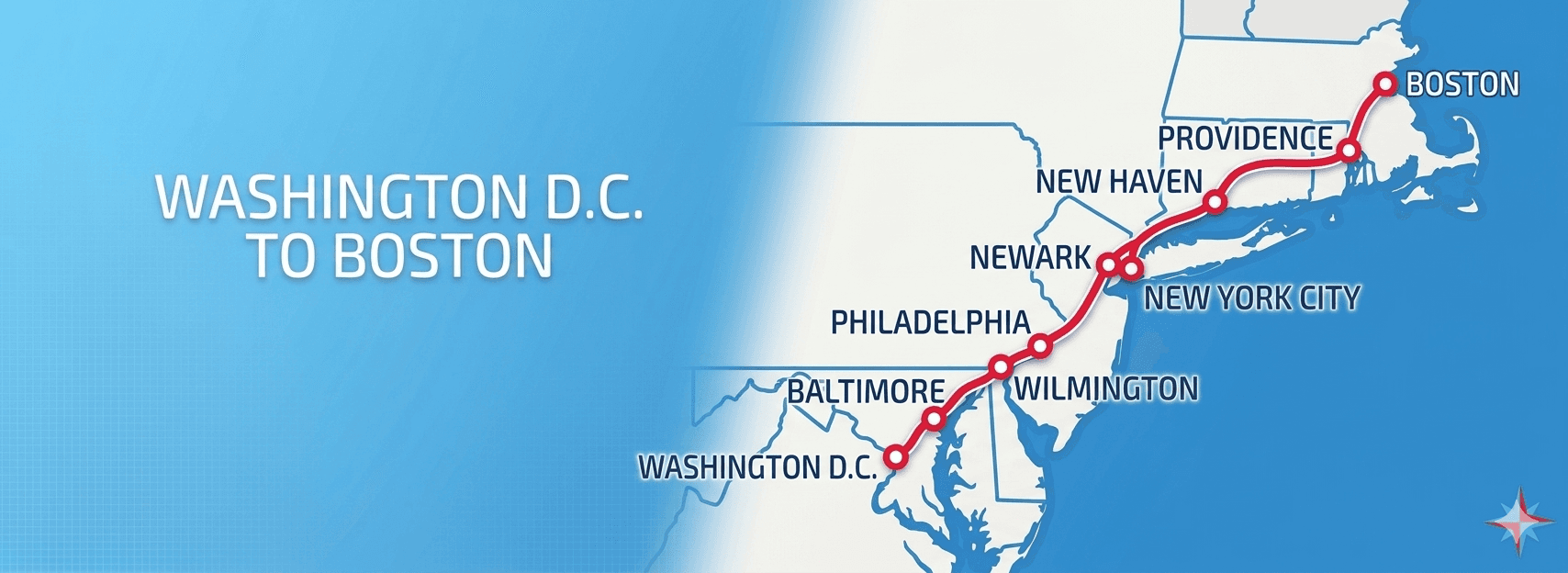
Washington, D.C. — New York City — Boston
The Northeast Corridor is the most economically productive transportation corridor in North America. Stretching from Washington, D.C. to Boston, it serves the densest concentration of economic activity in the United States — with a combined GDP of over $4 trillion, representing roughly 20% of U.S. national output.
And yet this corridor's rail infrastructure is among the oldest and most constrained in the developed world. The primary Amtrak service — Acela — travels the 229-mile Washington–New York segment in approximately 2 hours and 45 minutes, on shared track with commuter and freight services, at average speeds far below any credible high-speed rail standard.
SCMAGLEV offers a transformational alternative. Operating on a fully dedicated guideway at speeds above 300 mph, it would reduce Washington–New York travel time to approximately one hour — making the corridor function as a single, integrated economic zone and unlocking capacity that the existing system cannot provide.
Why SCMAGLEV for the Northeast
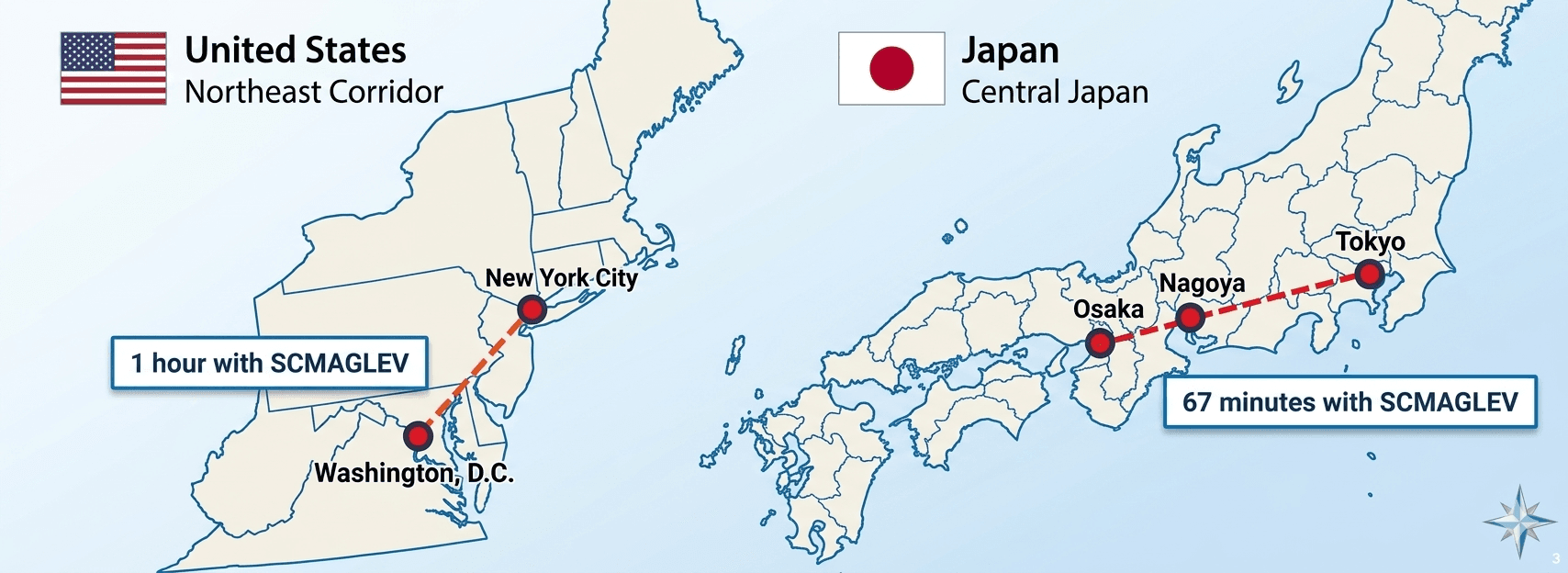
- GDP$4.04 trillion ($99k/person; 3× Japan)
- ScaleGreater than 5th largest country GDP
- Population41 million (DC – NYC)
- Distance229 miles
- GDP$2.19 trillion ($33k/person)
- ScaleGreater than 8th largest country GDP
- Population66 million
- Distance272 miles
Private-sector Japan Central Railways (JR Central) has operated high-speed rail (greater than 175 mph) since 1964. JR Central moves 158 million people per year with a train every four minutes, average delay under one minute, and with zero fatalities.
The Northeast Corridor GDP of $4.04 trillion — at $99,000 per person — is three times the per-capita output of Japan's equivalent central corridor. The economic case for investment is unambiguous.

Dallas and Houston are two of America's fastest-growing metros. The I-45 corridor connecting them is among the most congested in the nation, with no competitive rail alternative currently in service.
Dallas — Houston
The Dallas–Houston corridor represents one of the clearest high-speed rail opportunities in the United States: two major metropolitan areas, approximately 240 miles apart, with no intercity passenger rail service, an intensely congested highway link, and a combined population of over 14 million people growing at some of the fastest rates in the country.
The Shinkansen is the appropriate technology for this corridor. It is operationally mature, commercially proven, and aligned with the corridor's characteristics. The Texas terrain — largely flat, with relatively straightforward right-of-way — is well-suited to Shinkansen design parameters.
USJIA supports the development of this corridor as a context where the Shinkansen model has direct and immediate application. The case is not speculative — Japan has operated equivalent corridor distances with equivalent ridership demand for over 60 years.
Why Shinkansen for Texas
Portland — Seattle — Vancouver
The Cascadia megaregion encompasses one of North America's most rapidly growing economic zones, linking Portland, Seattle, and Vancouver, B.C. through a shared geography of technology industry, trade, and innovation. The three cities share deep economic ties but are connected by rail service that is slow, infrequent, and uncompetitive with regional aviation.
High-speed rail on the Cascadia corridor would transform the region's economic integration. The 185-mile Portland–Seattle segment, currently served by Amtrak Cascades at travel times of approximately 3.5 hours, could be served by Shinkansen in under one hour — converting the corridor from a day-trip inconvenience into a functional commuter network.
USJIA engages with Cascadia corridor planning as an emerging opportunity where the Shinkansen model is directly applicable and the public and political will for high-speed rail investment is growing.

The Cascadia megaregion is home to major technology companies, an expanding port economy, and a population growing faster than national averages. High-speed rail is a natural complement to its economic trajectory.